2026 · Randomised controlled trial · results
HER-SAFE: heart-failure therapy withdrawal after recovered HER2-related dysfunction
BC-OS co-authors: Tom Crake, Mark Westwood, Arjun Ghosh, Alexander Lyon, Malcolm Walker and Charlotte Manisty.
The trial randomised 90 breast cancer survivors with recovered HER2-related cardiac dysfunction. Over 12 months, moderate or severe dysfunction occurred in 1 of 45 evaluable participants assigned to withdrawal and 0 of 44 assigned to continuation. No symptomatic cardiac dysfunction or heart-failure hospitalisation occurred. These findings concern a selected population and limited follow-up; they do not establish universal or long-term safety of stopping treatment.
Dowsing B and colleagues. European Heart Journal. Published online 30 August 2026;ehag707.
2026 · AI-ECG research
AI-enhanced ECGs for predicting cancer therapy-related cardiac dysfunction
BC-OS co-authors: Ninian Lang.
Investigates AI-enhanced electrocardiography as a way to predict treatment-related cardiac dysfunction in the setting of BRAF/MEK inhibitor treatment. This entry highlights the research question; the linked article provides the study methods and performance results.
Zeidaabadi B and colleagues. Europace. 2026;28(8):euag191.
2026 · National survey study
UK research priorities: perspectives from professionals, patients and carers
BC-OS co-authors: David Austin, Charlotte Manisty, Anna Olsson-Brown and Ninian Lang.
Two UK surveys gathered responses from 127 healthcare professionals and 267 patients or carers. Prevention and early detection of cardiac problems emerged as priorities, helping to inform future collaborative studies. The findings describe respondents’ priorities rather than the effectiveness of a treatment.
Walls GM and colleagues. Cardio-Oncology. 2026;12:90. Published 20 May 2026.
2025 · Prospective cohort study
Cardiovascular effects of BRAF and MEK inhibitors in melanoma
BC-OS co-authors: Stephen Dobbin and Ninian Lang.
Among 61 participants, 28 developed cardiac dysfunction under the study definitions; 24 of these cases were mild. All four moderate or severe cases appeared by four weeks. This small observational study explores risk assessment and the timing of cardiac monitoring.
Glen C and colleagues. JACC: CardioOncology. 2025;7(7):852–866. First published online 10 October 2025.
2025 · Observational study · target trial emulation
Fluoropyrimidines: survival and cardiovascular outcomes in gastrointestinal cancer
BC-OS co-authors: Charlotte Manisty.
Using linked national records for 103,110 patients, the VICORI analysis associated fluoropyrimidine treatment with lower one-year mortality and a small increase in acute cardiovascular events. The observational design means residual confounding remains possible; the study is not a randomised treatment comparison.
Abiodun AT and colleagues. JACC: CardioOncology. 2025;7(4):345–356. First published online 8 April 2025.
2025 · Prospective imaging study
Early cardiovascular effects of VEGF inhibitors
BC-OS co-authors: Stephen Dobbin and Ninian Lang.
In a prospective study of 78 patients starting VEGF inhibitors, 15 developed cardiac dysfunction, with most cases evident at four weeks. Serial imaging, biomarkers and blood-pressure measurements explored early cardiac and vascular changes. The findings support further work on the timing of surveillance.
Dobbin SJH and colleagues. Heart. 2025;111(19). First published online 3 April 2025.
2024 · Randomised controlled trial
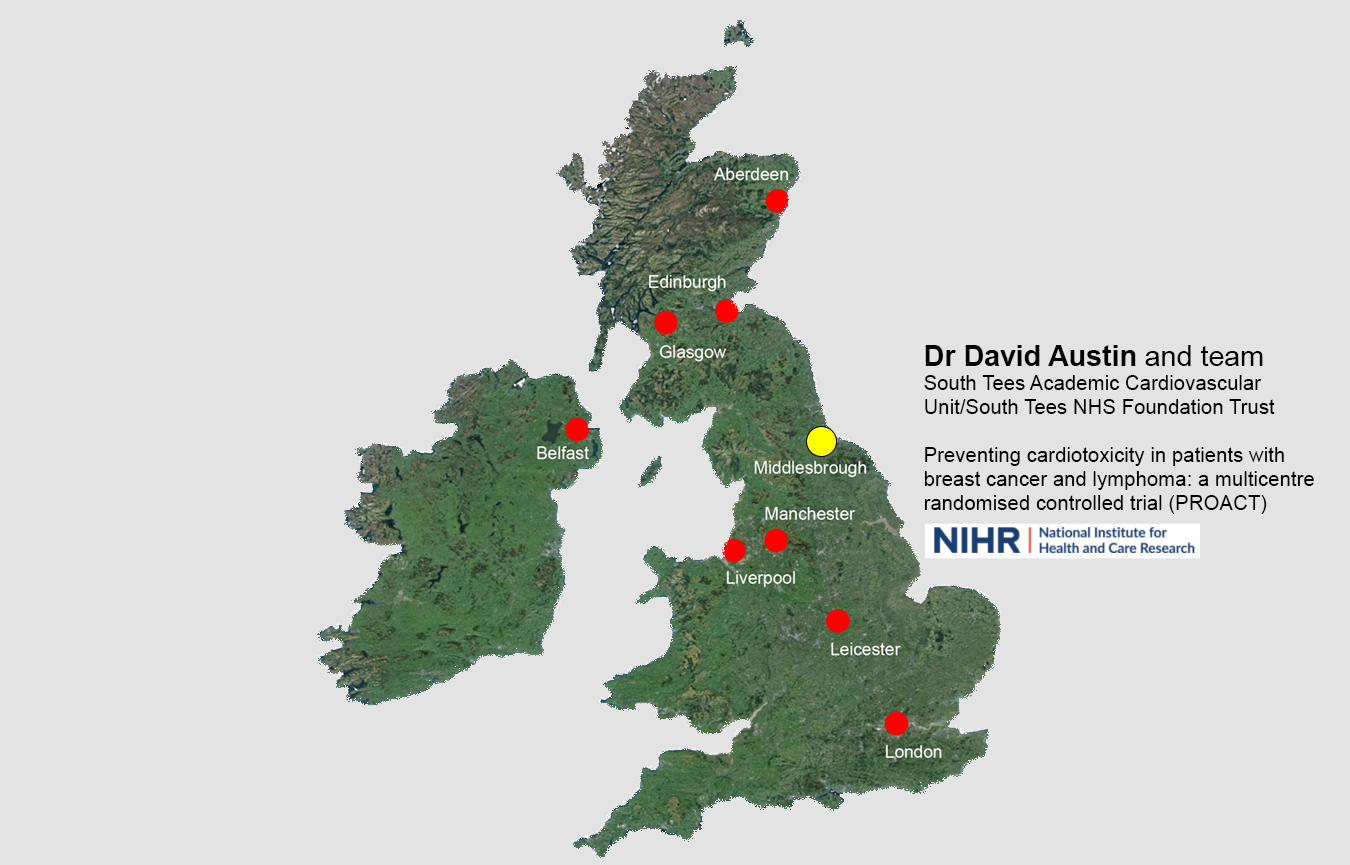
PROACT: enalapril during anthracycline chemotherapy
BC-OS co-authors: David Austin and Chris Plummer.
PROACT randomised 111 patients receiving high-dose anthracyclines for breast cancer or lymphoma to enalapril or standard care. It did not demonstrate prevention of cardiotoxicity with enalapril over the study follow-up. Results relate to this prevention strategy and population.
Austin D and colleagues. JACC: CardioOncology. 2024;6(5):684–696. Published online 27 August 2024.
Study plans are shown separately from publications reporting completed analyses.
2025 · Trial protocol · not results
HER-SAFE: planned withdrawal of heart-failure treatment after recovery
BC-OS co-authors: Arjun Ghosh, Alexander Lyon and Charlotte Manisty.
Describes a planned randomised trial of withdrawing heart-failure medication after recovery from HER2-targeted therapy-related cardiac dysfunction. The protocol planned to enrol 90 participants. This publication describes the design; trial results were subsequently published in August 2026 and are summarised above.
Dowsing B and colleagues. BMJ Open. 2025;15:e091917. Published 5 February 2025.